Omnichannel customer experience management: a maturity model
The final chapter of the thesis and the direct basis of OMMMICX: an eight-dimension, 60-criteria maturity model built on evidence and tested with management teams.
- Question
- Which actionable indicators reflect the level of experience management across multiple touchpoints?
- Method
- Criteria extracted from the 50 reviewed studies and the qualitative research, grouped through concept mapping and consolidated for synonyms.
- Validation
- Instrument applied with CX, technology and marketing managers in four organizations.
- Result
- Eight dimensions, 60 criteria and six maturity levels.
What it is about
The article presents and tests a maturity model built on eight dimensions relevant to omnichannel CX management. It allows teams to assess the current level of management based on a set of criteria and then address the identified gaps.
Its stated goal is to give guidance and a practical tool to teams and managers struggling to move from multichannel to omnichannel CX management, and to consultants who need to assess their clients.
How it was done
- 01Criteria were extracted from the 50 studies reviewed in chapter 4 and from the qualitative research in chapter 5.
- 02They were grouped through concept mapping, consolidated for synonyms and cleaned of redundancies down to 60 criteria across eight dimensions.
- 03A scoring scheme per criterion was defined, aggregated by dimension and turned into an overall maturity level.
- 04The instrument was applied and evaluated with CX, technology and marketing managers from four organizations, measuring perceived usefulness, clarity and recommendation.
What was found
- Eight dimensions: business strategy, channel management, customer experience, people and culture, data and analytics, processes, technology and brand management.
- Six maturity levels, from non-existent to optimized omnichannel.
- The model is consistent with industry maturity models such as Forrester Research's Digital Maturity Model 4.0 (2016).
- In validation, perceived usefulness and clarity were high and the instrument's NPS reached 87.5.
Study figures
Figures from the original manuscript, layout untouched and palette adjusted to the OMMMICX colors.
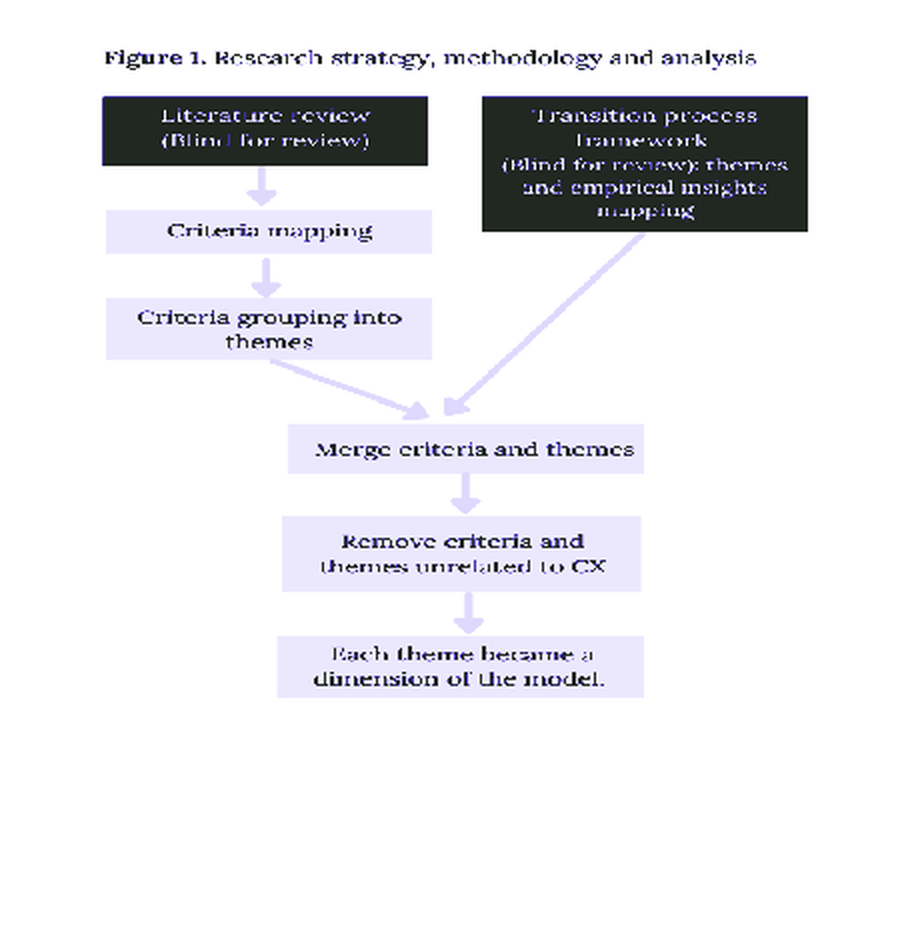
Research strategy
From the study corpus and qualitative research to criteria mapping and instrument validation.
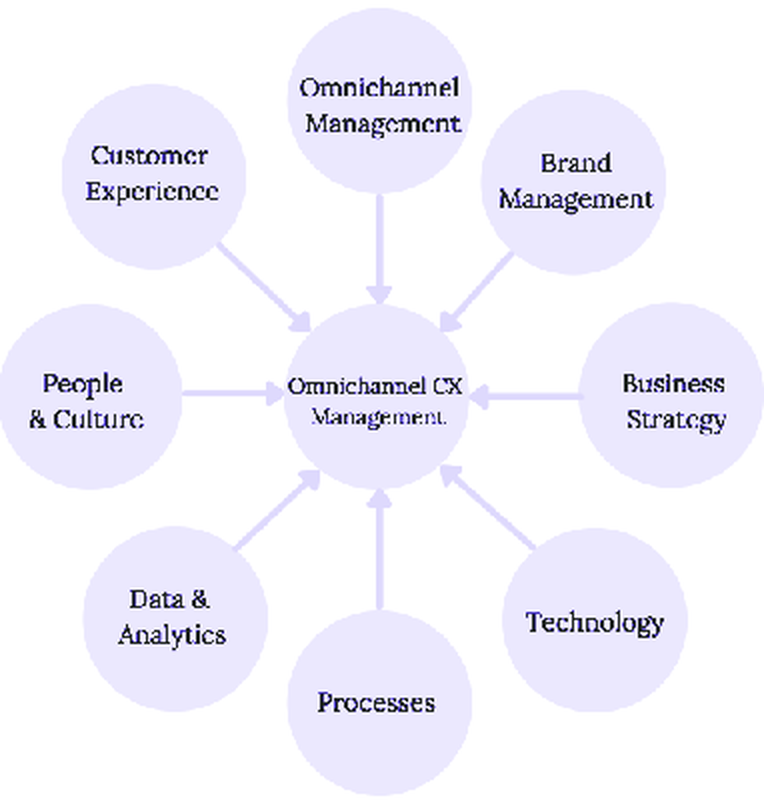
The eight dimensions of the model
Dimensions converging into omnichannel CX management.
Discussion
Discussion and conclusions from chapter 6, together with the cross-cutting reading in chapter 7.
Omnichannel maturity is an organizational state, not a technological one
Beyond its practical utility, the model makes a theoretical contribution: by integrating empirical evidence from a systematic review and qualitative practitioner research, it proposes a multidimensional conceptualization of omnichannel CX management that goes beyond channel integration or technology adoption. Omnichannel maturity is not primarily a technological or operational state, but an organizational one — shaped by strategy, culture, data capabilities and a customer journey orientation.
The dimensions remain current
The eight dimensions remain conceptually robust in light of recent empirical developments: research continues to validate the relevance of customer journey design, cross-channel engagement metrics, safety as a CX dimension and AI as a transversal amplifier of omnichannel capabilities. The persistent absence of an academically grounded maturity model reinforces the relevance of this contribution.
Self-assessment subjectivity
As with any self-assessment method, measuring maturity from the point of view of managers and consultants keeps some degree of subjectivity. Future work should complement results with objective data on organizational behavior — what teams actually do — and with the customer perspective. Customer feedback instruments would be a valuable complement within a broader framework for evaluating perceived omnichannel CX.
Evolution of the instrument
The chapter anticipates shorter versions of the model, consolidating high-level criteria — for example, consistency operationalized as service, product and price consistency — and removing those almost never or almost always met. It also proposes adding new criteria, such as AI adoption, and taking the model to a web platform with content explaining how it works and how scoring is calculated before the call to action: precisely what this site does.
Being fully omnichannel can be utopian
The final conclusion is deliberately sober: being fully omnichannel can be somewhat utopian. Each organization should design an intended experience — a standard defined by brand definitions, segment expectations, product or service category and industry context — that improves over time with customer feedback and business results.
Limits
- Validation used a small sample in a specific country, so results may not generalize to other populations.
- In smaller organizations, some criteria may be complex or unrealistic given the resources they demand.
- As a self-assessment, it retains subjectivity; it should be complemented with behavioral data and the customer voice.
- A longitudinal study with before-and-after measurement would show the organizational impact of adoption over time.
How to cite
Gerea, C. (2026). Omnichannel Customer Experience Management: A Maturity Model. Chapter 6 of the doctoral thesis 'Omnichannel Customer Experience: Research and Management of a Co-created Evolving Experience', Pontificia Universidad Católica de Chile.
See the origin of the modelApply the model to your organization
Eight dimensions, 60 criteria and a report with your gaps, in 10 to 12 minutes.
Assess my organization