Omnichannel customer experience and management: an integrative review and research agenda
The systematic review that organized the field: from 1,657 initial results across seven databases to 50 peer-reviewed empirical studies published between 2008 and May 2020.
- Question
- What is the state of the omnichannel customer experience research field and what are its streams?
- Method
- Systematic literature review across ACM, IEEE Xplore, ProQuest, ScienceDirect, Scopus, SpringerLink and Web of Science.
- Corpus
- 1,657 → 164 → 80 → 50 peer-reviewed empirical studies (2008 – May 2020).
- Result
- Seven research streams, dominant theoretical perspectives and a research agenda.
What it is about
The article reviews, in an integrative way, how academia has addressed customer experience in omnichannel contexts. It identifies the existing research streams — customer behavior, segmentation, interaction with in-store technology, omnichannel management, service quality, the omnichannel CX construct and its outcomes — and the theoretical perspectives behind them.
This is the study that makes visible the gap the thesis eventually fills: the absence of guidance to assess and manage omnichannel experience, and the underrepresentation of service industries compared with retail.
How it was done
- 01A systematic review protocol defined the search string, inclusion and exclusion criteria, and double review by two researchers to reduce bias.
- 02The search across seven databases returned 1,657 results. After removing duplicates and applying inclusion criteria, 164 remained; abstract screening reduced them to 80; full reading left 50 empirical studies.
- 03Each study was characterized by discipline, country, B2B/B2C context, industry, research approach, subject of study and touchpoints analyzed.
What was found
- From the consumer perspective, customer behavior, segmentation and interaction with in-store technology dominate.
- From the organizational perspective, omnichannel management and service quality are the most covered topics.
- Although omnichannel has been researched for more than ten years, omnichannel CX as a specific topic remains seldom explored, with most studies focused on the shopping experience.
- Service industries are underrepresented compared with retail, which set the sector focus of the following studies.
Study figures
Method figures of the reviewed corpus, reproduced with the original layout and an adjusted palette.
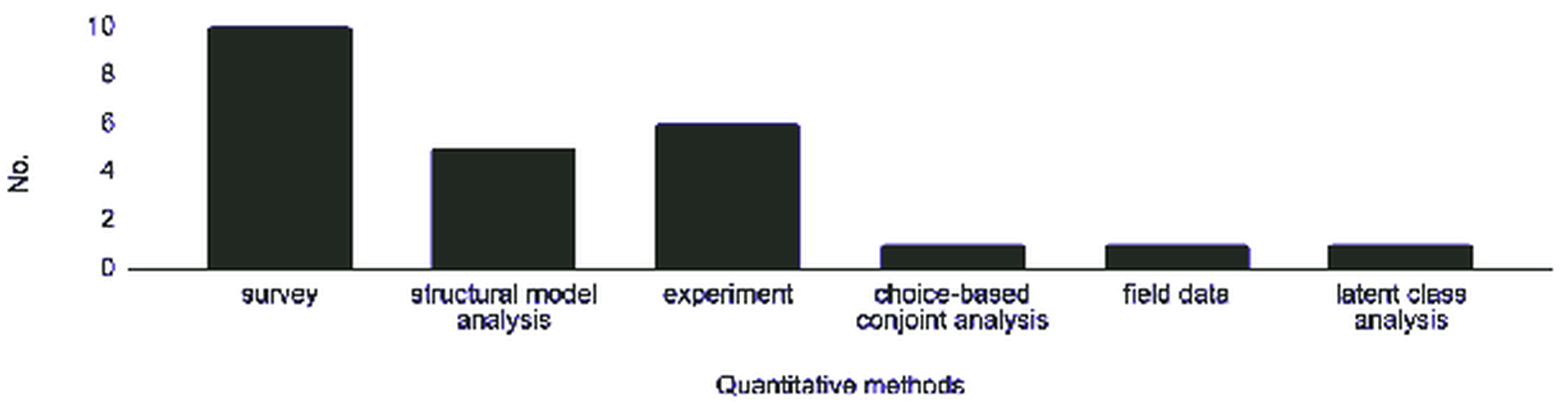
Quantitative methods in the corpus
Distribution of quantitative methods across included studies: surveys dominate.
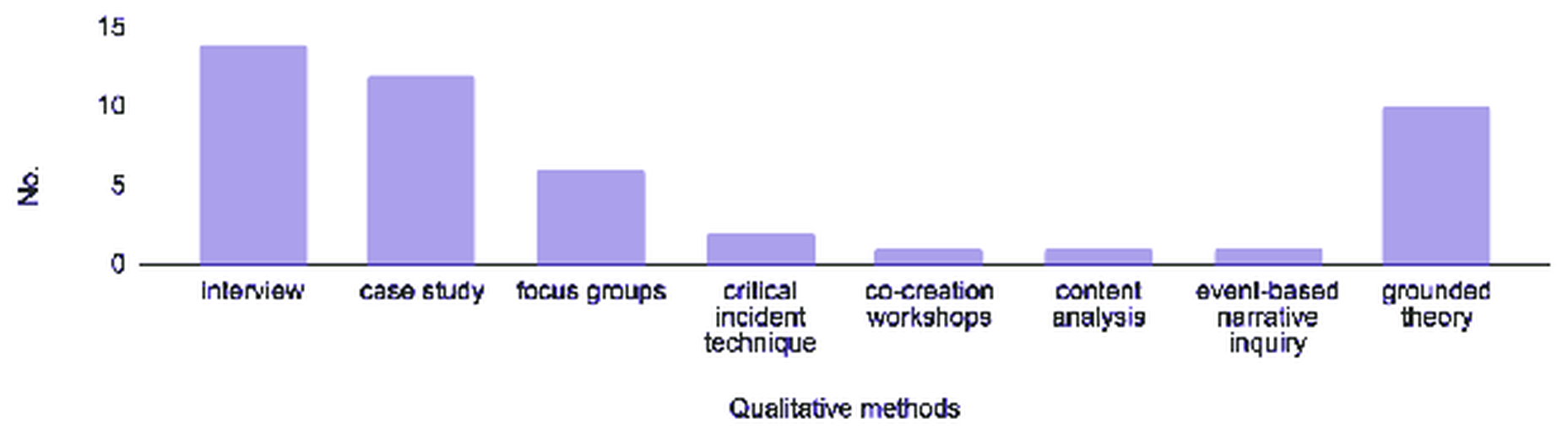
Qualitative methods in the corpus
Distribution of qualitative methods across included studies.
Discussion
Chapter 4 discussion, complemented by its reading in chapter 7.
The field is fragmented, and that is the opportunity
The analysis shows a wide variety of topics investigated from different theoretical perspectives, with overlapping scopes. It is precisely in those shared spaces that the field can be integrated. Approaching omnichannel CX management from an integrated theoretical perspective requires proposing guidelines for practical assessment, measurement and evaluation: the challenge the thesis takes on in the following chapters.
Interdisciplinary work is missing
Although the results are coherent with the search string used, more interdisciplinary work was expected. There is an open research opportunity at the intersection of marketing, management and computer science.
Vocabulary matters when asking
The concepts of 'channel' and 'omnichannel' are familiar to retail practitioners, but not to consumers. Qualitative work with customers must adapt the language to their mental references and consider methods other than surveys or interviews: when asked directly, people are poorly or not at all familiar with omnichannel concepts and perceive they live an experience with a brand, not with a channel.
From the gap to the model
The resulting research agenda includes the operationalization of omnichannel CX, the customer lifecycle, management on marketplaces, integration of new touchpoints, predictors of customer behavior and omnichannel services. Chapter 6 answers the first of those points with a maturity model, and chapter 7 notes that the absence of an academically grounded maturity model persisted in recent literature.
Limits
- The review was built on a specific search string: other work may have addressed the topic with different terminology.
- Specific academic databases were queried, so publications from other sources were excluded.
- Researcher bias was mitigated with double review, but cannot be fully removed.
- Included studies come from diverse industries, countries and contexts, which makes comparison and generalization complex.
How to cite
Gerea, C., Gonzalez-Lopez, F., & Herskovic, V. (2021). Omnichannel Customer Experience and Management: An Integrative Review and Research Agenda. Sustainability, 13(5), 2824.
View publication in Sustainability (MDPI)The missing operationalization
The OMMMICX maturity model turns this review into 60 assessable criteria across eight dimensions.
Assess my organization