From multichannel to omnichannel in service-based companies: challenges and coping strategies
The study that contributed the management vocabulary of the model: what enables, what blocks and what triggers the transition from multichannel to omnichannel experience management.
- Question
- What enables and what blocks the transition from multichannel to omnichannel customer experience management?
- Method
- Two-phase qualitative research, before and during the pandemic: 11 in-depth interviews and group sessions with 13 professionals.
- Industries
- Telecommunications, banking, insurance, retail, airlines, education and consulting.
- Result
- A framework of the transition process with enablers, challenges, drivers and context.
What it is about
The study reconstructs, through the voices of those managing experience in service companies, how organizations move from running channels separately to managing a continuous experience. Data collection spanned the moments before and after the start of the pandemic, making the accelerating effect of context visible.
The analysis produced a framework with five enablers, three major challenges, three drivers and a context of macro trends.
How it was done
- 01Phase 1: 11 in-depth semi-structured interviews with professionals responsible for experience, channels or digital transformation.
- 02Phase 2: online group sessions with 13 professionals, to contrast and deepen findings in the new context.
- 03Iterative thematic analysis until data saturation, followed by construction of the conceptual framework.
What was found
- Enablers: a strategic customer-centric mindset at scale, brand customer-centric outcomes, unified CX metrics, integrated systems and willingness to invest.
- Challenges: human talent, organizational culture and organizational behavior.
- Drivers: COVID-19, client acquisition articulation and after-sales customer relationships.
- Context: macro trends reshaping the competitive landscape for service-based companies.
- Enablers alone are not enough to adopt omnichannel capabilities at scale: drivers are needed to trigger the process.
Study figures
Figures from the original article, same layout with the brand palette applied.
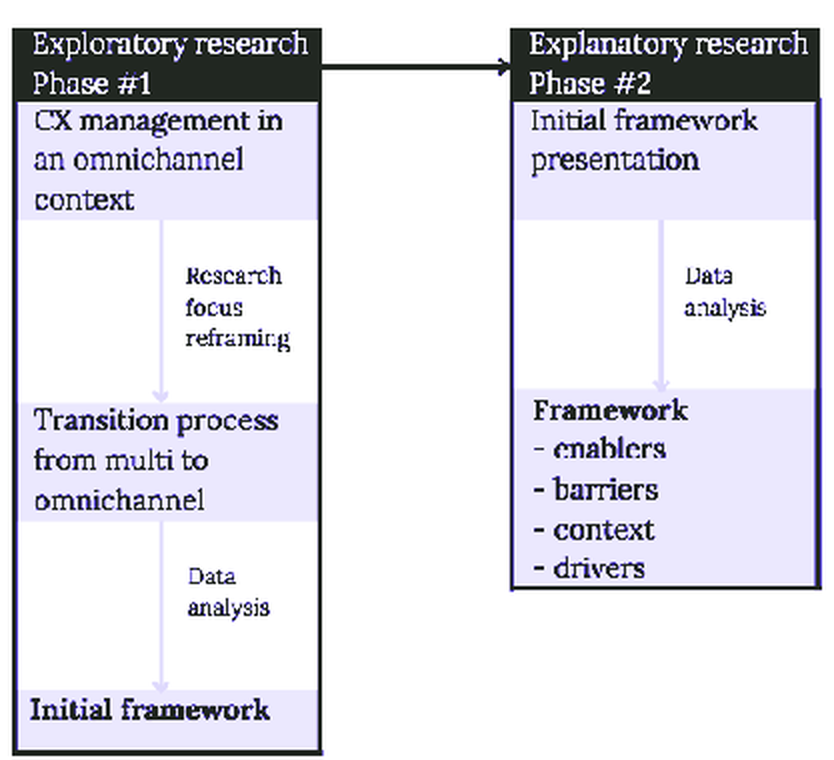
Research process
The two data collection phases and their analysis.
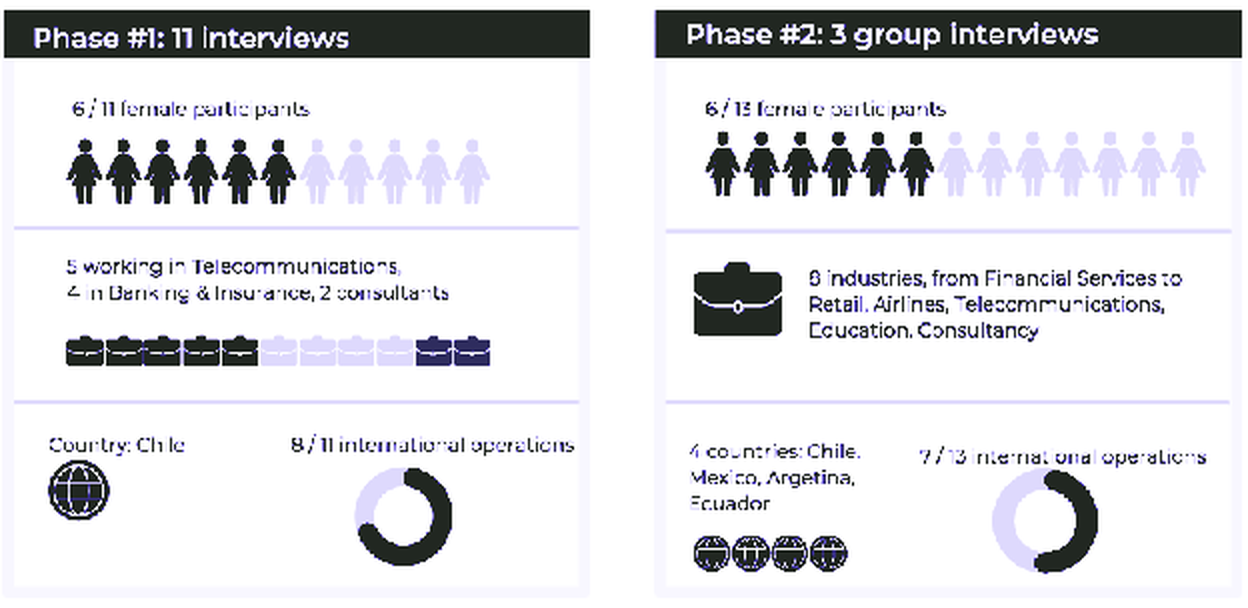
Participants
Participant profiles by industry and role.
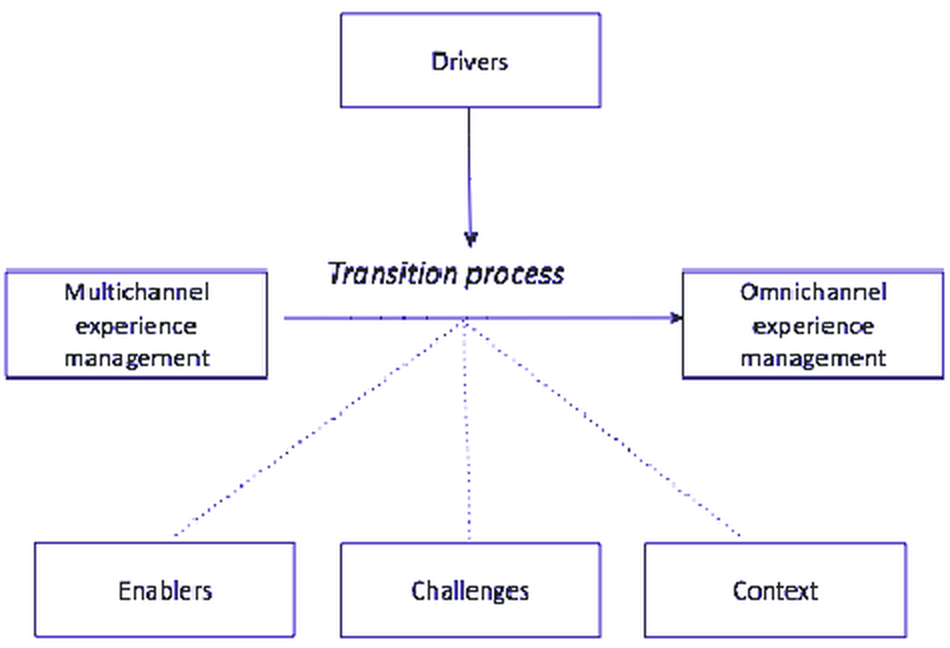
Transition framework
Enablers, challenges and drivers of the evolutionary process within their context.
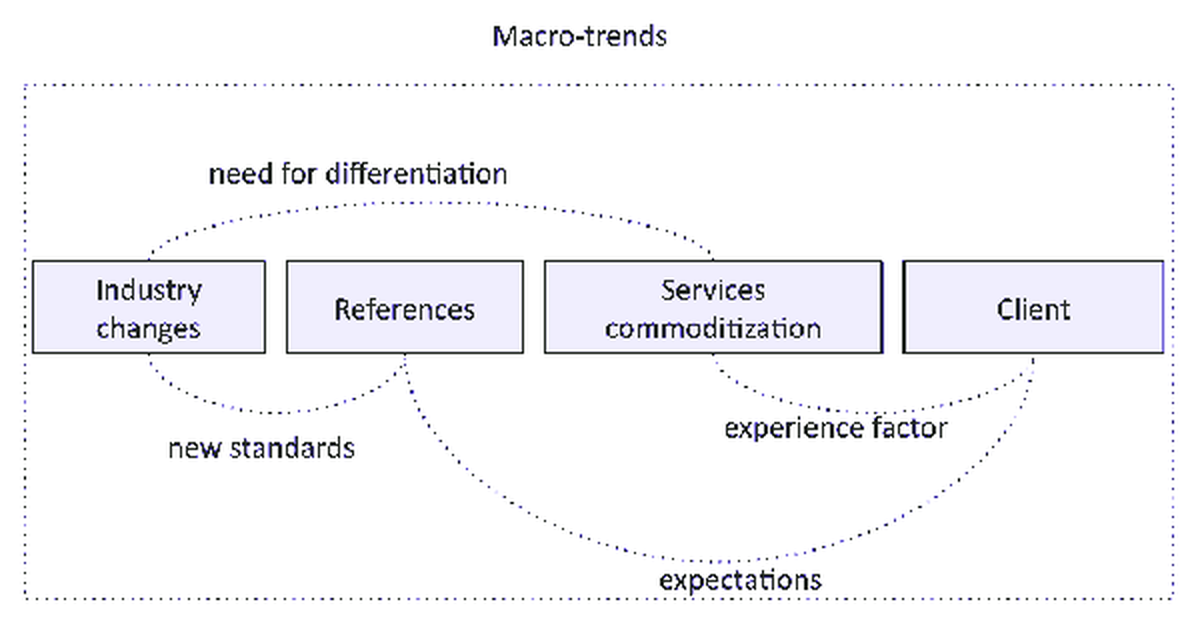
Context macro trends
Trends framing competition in service industries.
Discussion
Concluding thoughts and implications from chapter 5, which explicitly anticipate the chapter 6 maturity model.
Enablers are not enough
As a theoretical contribution, the framework posits that enablers are not enough to trigger the adoption of omnichannel CX capabilities at scale. Drivers such as COVID-19, client acquisition articulation and after-sales customer relationships are strong triggering factors. These components do not live separately: in a complex system, internal and external factors reinforce each other when they coincide.
Managerial implications
For senior management, if omnichannel is a strategic issue, it is time to rethink classical channel ownership: the structure should be customer-driven, not channel-driven, because people interact with a brand rather than with specific channels. For middle managers in organizations not born digital, digital skills are needed to empower teams through the process, otherwise internal conflicts arise with digital teams. For C-level, omnichannel strategy should align with company purpose as a top-down priority.
Metrics by moments, not by channel
If integrated metrics are needed and channel ownership is redesigned or discarded, then metrics should not be measured by channel but by critical moments of the customer journey or as high-level brand experience metrics. Even if not actionable, NPS remains a relevant brand-level metric for team alignment and benchmarking.
The bridge to the maturity model
The chapter itself states that future research should include an omnichannel CX management maturity level, allowing managers to apply a self-assessment methodology to identify gaps before transitioning from multichannel to omnichannel. That is exactly what chapter 6 — and this site's tool — answers.
Limits
- Time and resource constraints limited the industries represented: financial services, airlines, telecommunications and education, plus consulting profiles with a cross-industry view.
- Although data saturation was reached, the sample is small and does not aim at generalization but at understanding the issues raised.
- The focus is on CX aspects in service companies: in retail, logistics and reverse logistics would have carried more weight.
- The framework captures the managers' perspective; the customer voice still needs to be systematically incorporated.
How to cite
Gerea, C., & Herskovic, V. (2022). Transitioning from Multichannel to Omnichannel Customer Experience in Service-Based Companies: Challenges and Coping Strategies. Journal of Theoretical and Applied Electronic Commerce Research, 17(2), 394–413.
View publication in JTAERThe self-assessment this study called for
Identify your gaps by dimension before redesigning channels or structure.
Assess my organization