New paths in small manufacturing: digital transformation between designers and craftspeople
A community study showing why channel availability does not guarantee continuity: without intentional orchestration, conversation holds during the project and fades afterwards.
- Question
- How is digital transformation shaping collaboration between designers and craftspeople?
- Method
- Three-phase qualitative study: 12 semi-structured interviews, analysis of eleven months of WhatsApp conversations and a co-design session with 17 participants.
- Analysis
- Thematic analysis with Atlas.ti; 517 coded statements in the messaging group.
- Case
- SaberHacer community of practice (designers and craftswomen).
What it is about
SaberHacer brought designers and craftswomen together around small manufacturing projects. The study observes how that collaboration was sustained with everyday digital tools — instant messaging, social networks — and what happened to the community once in-person activities ended.
Although the case is not about corporate omnichannel, it contributes the observation that organizes the following studies: continuity of an experience depends on how channels are orchestrated, not on how many are available.
How it was done
- 01Phase 1: 12 semi-structured interviews with community members, reconstructing its history and practices.
- 02Phase 2: analysis of eleven months of the community's WhatsApp conversations, with open coding grouped into code families.
- 03Phase 3: a co-design session with 17 participants to contrast findings and project collaboration-support solutions.
What was found
- Conversations clustered into seven themes: business opportunities, activities and events, communication channels, everyday conversation, specific knowledge, projects and product design.
- The coordinator concentrated the largest number of statements and shared opportunities: her facilitation role was decisive in keeping the community alive.
- Instant messaging supported post-workshop interactions well, but did not support knowledge creation over time or event management.
- No digital tool replaced face-to-face interaction when it came to building long-term commitment.
Study figures
Figures reproduced from the original manuscript with the same layout; resolution and palette were adjusted.
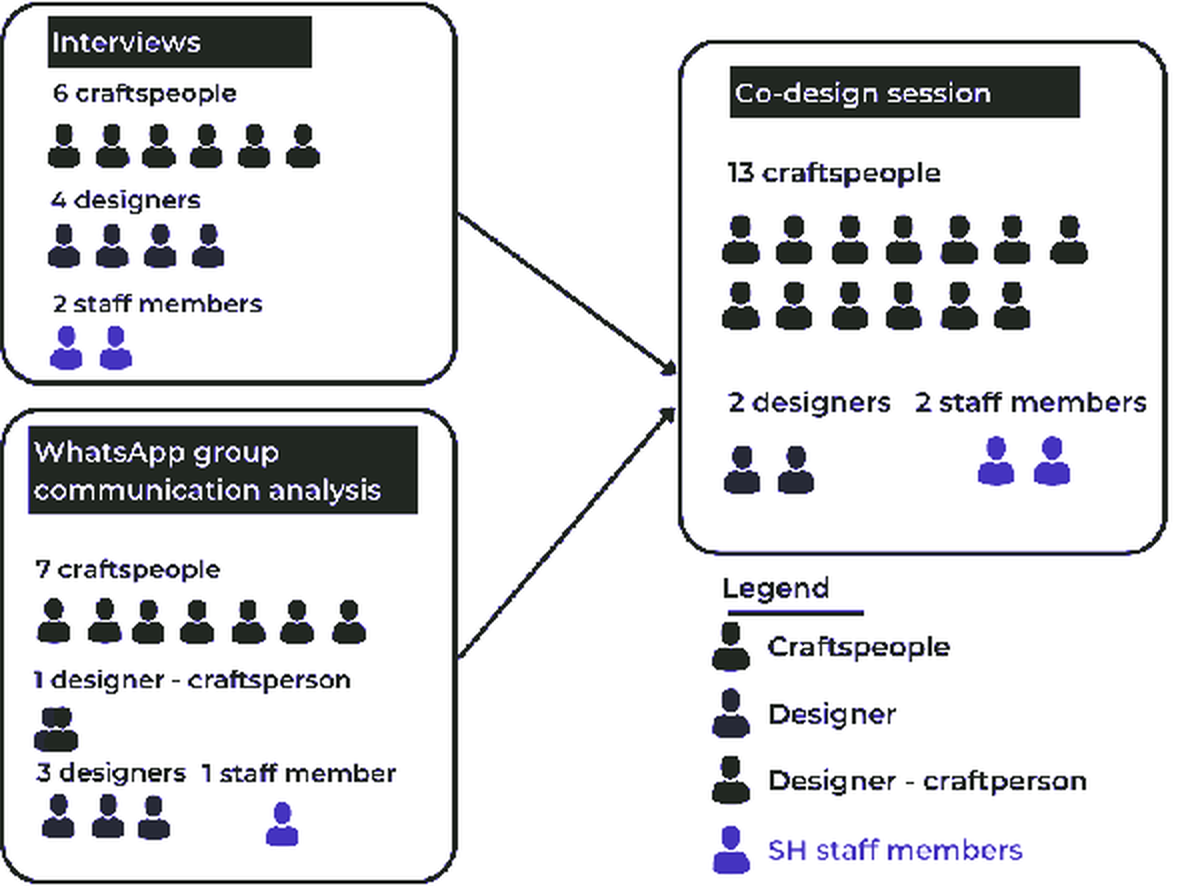
Research strategy
The three phases of the study and how they chain together.
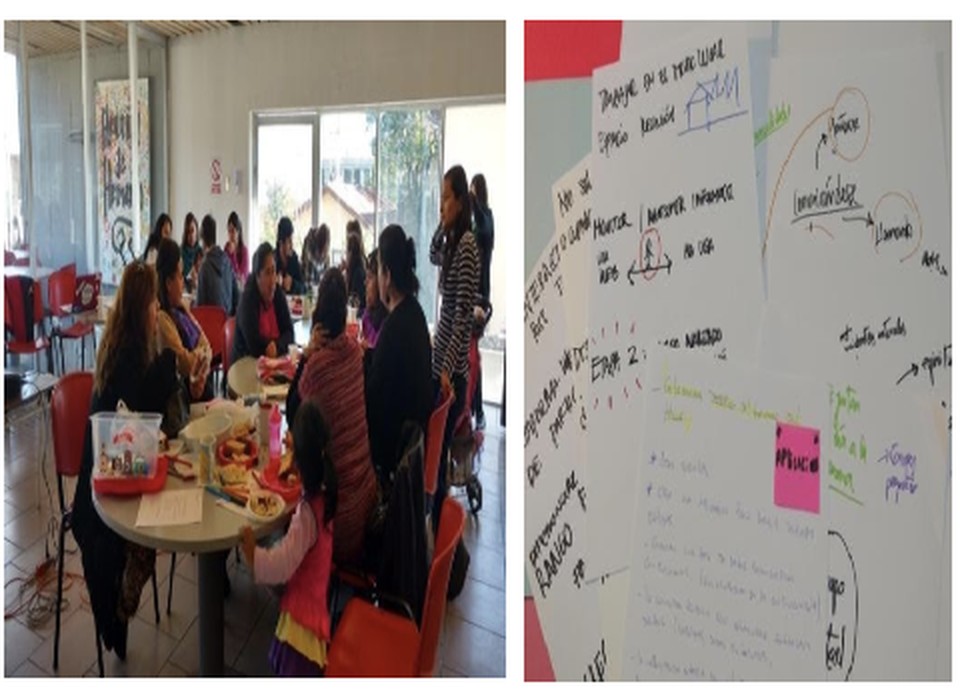
Co-design session
Participants and artifacts generated during the co-design session.
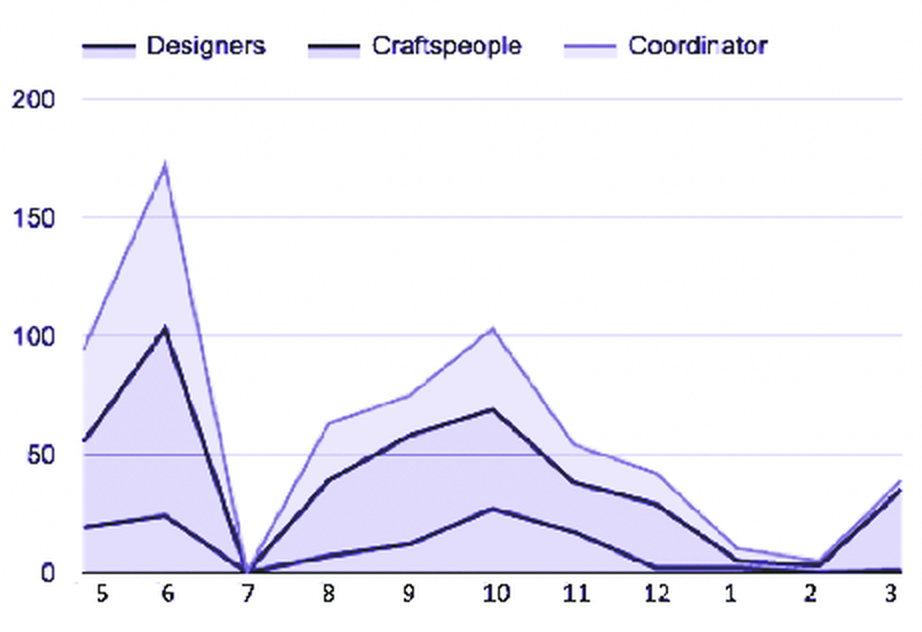
Evolution of conversations
Conversation volume of the group over eleven months.
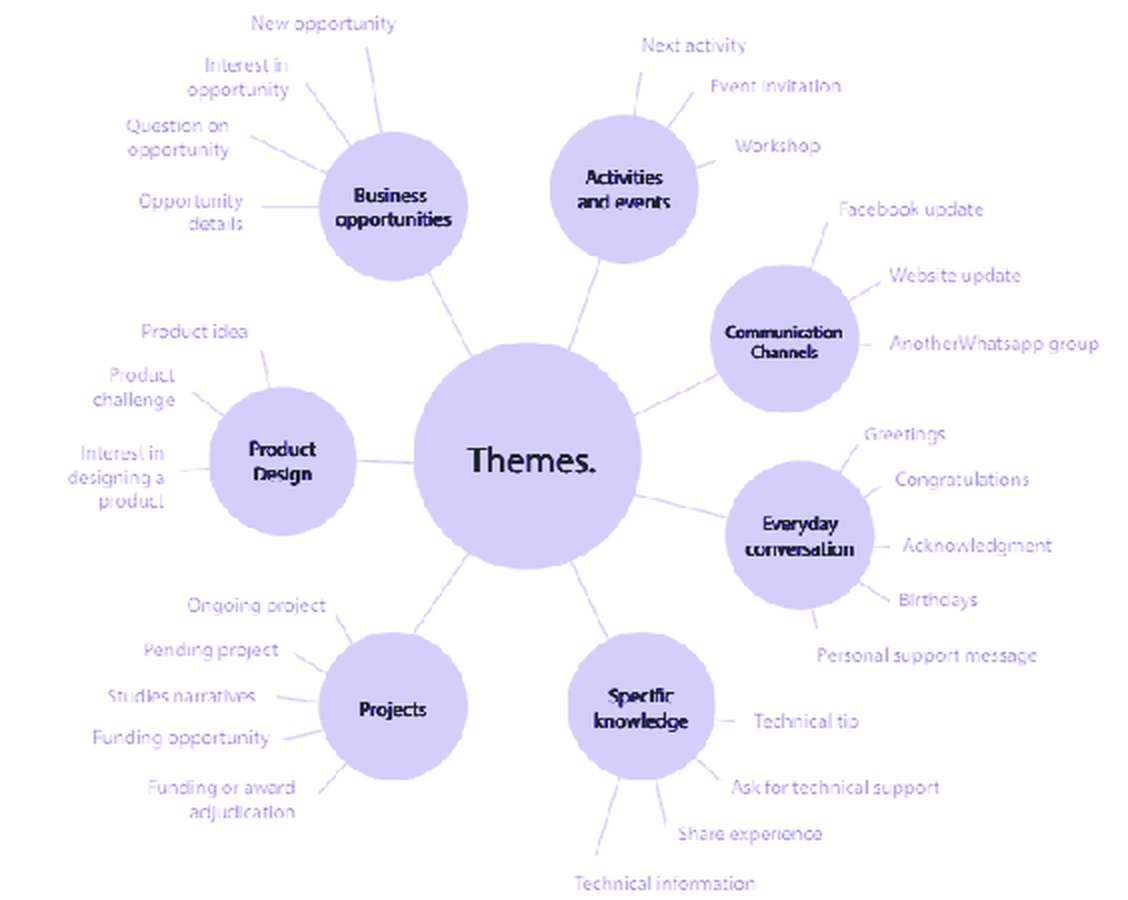
Conversation themes
Seven code families across 517 coded statements.
Discussion
The chapter 3 discussion engages with literature on instant messaging within communities of practice.
Messaging favors topics, not projects
Findings are consistent with recent research showing that instant messaging tends to enable topic-oriented rather than project-related conversations (Costa-Silva et al., 2022). In this community, for activities and events to gain traction the coordinator had to create events and ask for confirmation on Facebook, which supported that activity better.
A single group saturates
Even though WhatsApp was accessible and already in use, over time a standalone messaging group generates an overwhelming amount of conversation. The growing number of topics and notifications makes it hard to keep up, consistent with research on online group chat (Pasad et al., 2020). The temporary fix was creating topic-specific groups, a practice that becomes limited and time-consuming for the coordinator.
Digital does not replace in-person
None of these online tools replace face-to-face interaction when it comes to long-term commitment and community sustainability. Note that at the time of the study WhatsApp had no community management features; the Communities feature launched in November 2022 and requires specific validation.
Translation to the omnichannel problem
Read from chapter 7, this study supplies the underlying argument of the rest of the thesis: experience is sustained by orchestration and by roles that keep it alive, not by the number of available channels. The same logic reappears in organizations that call themselves omnichannel because they are present in many channels.
Limits
- The group was still active during the study: it is unclear what would have happened without the coordinator, whose facilitation role was central.
- The study does not show how a self-sustaining community of practice forms without a facilitator.
- Single case, with transferable but not generalizable findings.
How to cite
Gerea, C., et al. (2023). New Paths in Small Manufacturing: How Is Digital Transformation Shaping Collaboration Between Designers and Craftspeople? SAGE Open.
View publication in SAGE OpenDoes your organization orchestrate channels, or just have them?
The self-assessment reviews channel orchestration as a dimension of its own.
Assess my organization